

[Dec 1] Nuclear Necropolitics and the Genealogy of Empire [Two talks]
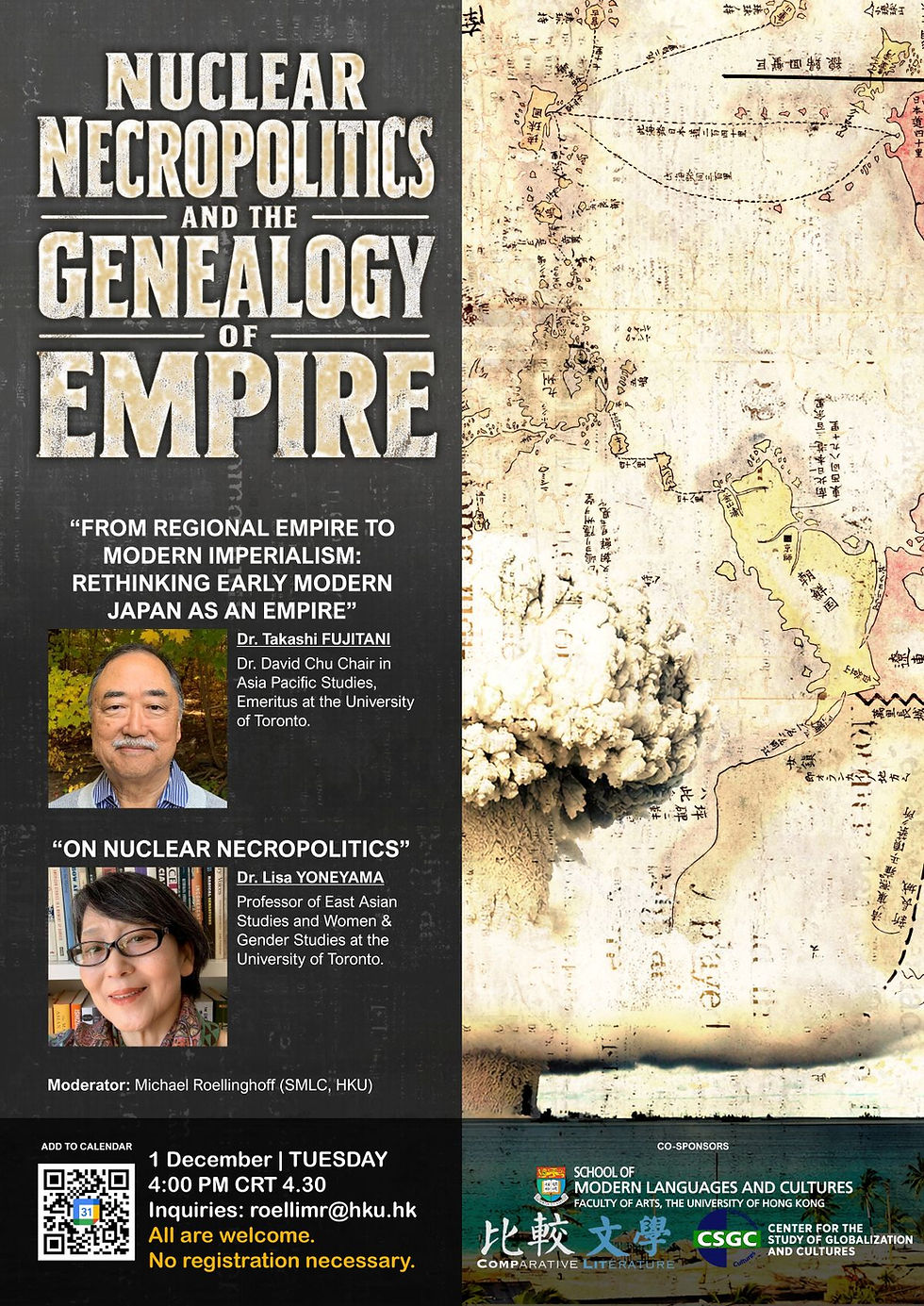
Date: December 1, 2026 (Tue)
Time: 16:00
Venue: CRT-4.30 (4/F, Run Run Shaw Tower, Centennial Campus, HKU)
Moderator: Prof. Michael Roellinghoff | Assistant Professor of Japanese Studies | The University of Hong Kong
Talk 1: From Regional Empire to Modern Imperialism: Rethinking early modern Japan as an empire
Speaker: Dr. Takashi Fujitani | Dr. David Chu Chair in Asia Pacific Studies | Emeritus at the University of Toronto
Abstract:
By now scholars have thoroughly discredited the idea that Japan during the Tokugawa period (1603-1868) was a closed country (sakoku) isolated from the world, but few have dared to reconceptualize Japan in this period as its apparent opposite: an empire that was in many ways comparable to early modern European empires. The presentation argues that while Toyotomi Hideyoshi’s invasion of Korea in the late-sixteenth century failed, his dream of empire was realized in the relationship of the Tokugawa regime to the han domains, to the Ryūkyū Kingdom, and to Ezo (Hokkaido). The point is not to draw a straight line of continuity between the early modern and modern Japanese empires, but rather to understand the distinctive characteristics of the two imperial formations and their effects upon especially the Ryūkyū Kingdom (Okinawa) and the indigenous peoples of Ezo (Hokkaido).
Speaker’s Bio:
Takashi Fujitani is the Dr. David Chu Chair in Asia Pacific Studies, Emeritus at the University of Toronto. His major works include: Splendid Monarchy (UC Press, 1996); Race for Empire: Koreans as Japanese and Japanese as Americans During WWII (UC Press, 2011); and Perilous Memories: The Asia Pacific War(s) (co-edited, Duke U. Press, 2001). He is editor of the book series Asia Pacific Modern (UC Press) and has held numerous grants and fellowships, including from the John S. Guggenheim Foundation. He is currently working on several books: The Japanese Empire (under contract with Polity Press); Promise of Freedom: Nation, Empire, and Sovereign in Japan’s Modernity; and Cold War Clint: Asians, “Indians” and Others in an American Political (Un)conscious.
Talk 2: On Nuclear Necropolitics
Speaker: Dr. Lisa Yoneyama | Professor of East Asian Studies and Women & Gender Studies | University of Toronto
Abstract:
My workshop presentation will address the relationship between nuclear criticism and Achille Mbembe’s concept of necropolitics. In recent years, scholars concerned with nuclear issues have increasingly turned to Mbembe’s work to theorize premature death and disposability at various nuclearized sites and through various nuclear activities—from mining, refining, waste disposal to the testing and actual use of nuclear weapons, as well as accidents at nuclear power plants. What can we gain by examining today’s deeply nuclearized world through Mbembe’s conceptualization of necropolitics? What dimensions of Mbembe’s argument acquire particular urgency when considered in relation to the disproportionate burdens of violence distributed across unevenly nuclearized sites and populations? By exploring recent works of nuclear criticism, this presentation illuminates the tension between the demand for analytics attentive to geohistorical distinctions among specific nuclear “death-worlds” and the drive to subsume Mbembe’s “repressed topographies of cruelty” under the universal human.
Speaker’s Bio:
Lisa Yoneyama is Professor of East Asian Studies and Women & Gender Studies at the University of Toronto. She received her Ph.D. in Anthropology from Stanford University and taught cultural studies in the Department of Literature at the University of California, San Diego, where she also served as director of the Critical Gender Studies program. Yoneyama’s research examines the politics of memory, violence and justice, with a particular focus on transpacific knowledge production. Her publications include Hiroshima Traces (UC Press, 1999), Perilous Memories (co-edited, Duke University Press, 2001), Violence, War, Redress (in Japanese, Iwanami Shoten, 2003), and Cold War Ruins (Duke University Press, 2016), which received the 2018 Best Book Award from the Association for Asian American Studies. Yoneyama’s current book project, “Co-Conjuring Decolonial Nuclear Criticisms,” has been supported by a SSHRC Insight Grant.
All are welcome. No registration is needed.
For enquiries, please contact Prof. Michael Roellinghoff at roellimr@hku.hk


Comments